Should you sell your business now? Or wait?
This is one of the most common questions we hear from founders. And while the answer is nuanced, there are a few ways to think about this that can be helpful.
Most entrepreneurs think timing a business sale is all about market conditions — selling when valuations are high and buyers are plentiful. Don’t make this mistake. While market timing can certainly impact your sale price, it’s just one piece of a larger puzzle.
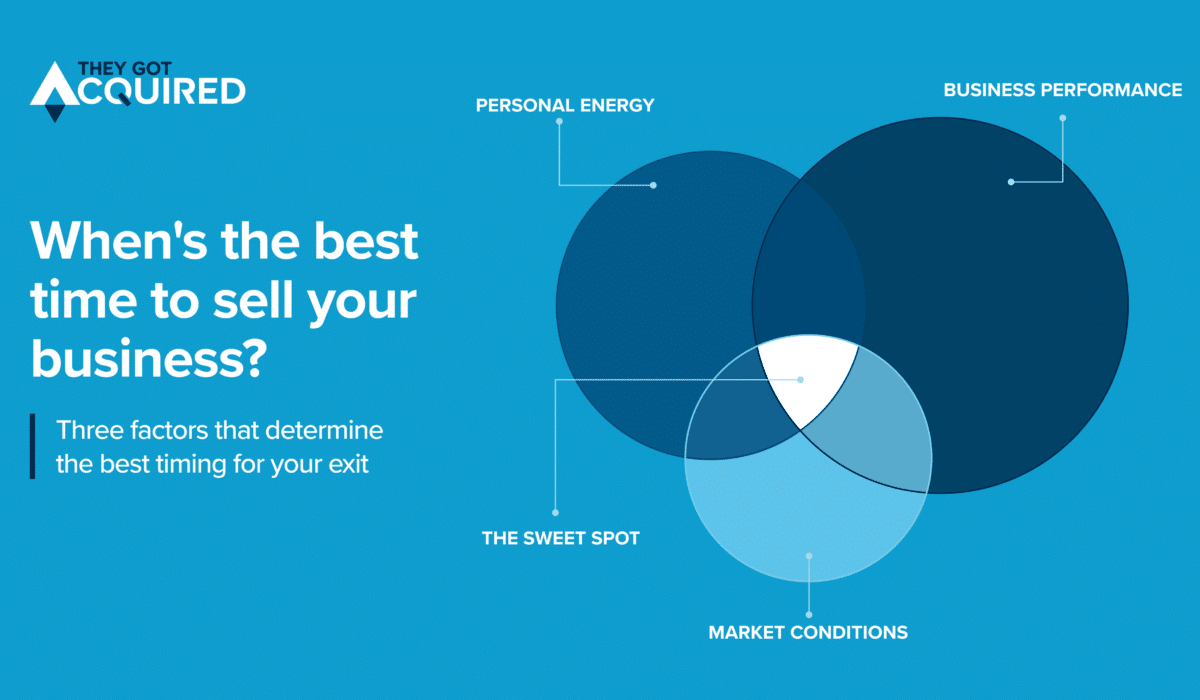
After interviewing hundreds of founders who’ve successfully sold their businesses, we’ve identified three key factors that affect timing for when it’s smart to sell. Only one of them is market timing, and it’s not even the most important one.
Here’s what really matters when deciding if it’s the right time to exit your business.
Would you prefer to listen to learn about timing your sale? We talk about this topic on our podcast:
The 3 factors that determine the best time to sell
1. Your business performance (most important)
The health and trajectory of your business is by far the most critical factor in determining when to sell.
The ideal time to sell is when your business is on an upward trajectory. Revenue and profit look strong, and the business is growing year-over-year. Remember, buyers aren’t just buying your current performance — they’re betting on the future potential of what you’ve built.
This growth factor is consistently undervalued by founders. Most founders want to keep plowing ahead when the business is growing. That’s an excellent option!
But you also want to show growth when you go to sell the business. Offers from buyers will likely not be as strong if you wait until the business has plateaued to sell.
That’s because sale multiples are growth dependent, said Einar Vollset of Discretion Capital. “Because growth dominates all other factors when it comes to valuation multiple, you should sell your business when there’s still some growth left.”
The lesson: Don’t wait for peak performance. Many founders make the mistake of trying to time their exit perfectly, holding on until they’ve squeezed every last drop of growth from their business. But you need some of that upward momentum to make your business attractive to buyers and get maximum value at sale.
The key is selling while you still have runway ahead of you, not after you’ve hit a plateau or started to decline.
2. Your personal energy and motivation (often overlooked)
This factor is frequently undervalued, but it’s crucial for a successful sale.
Selling a business requires significant energy and focus. The process typically takes 4-9 months and involves intense periods of due diligence, negotiations, and maintaining business performance while managing the sale process simultaneously.
Pramod Dabir, who sold engineering firm West Agile Labs, said his biggest challenge during the sale was running the company and selling it at the same time, describing that juggle as “basically doing two full-time jobs.”
That’s why, in an ideal world, you should sell before you burn out.
The best time to sell from an energy perspective is when you still have the motivation to:
- Optimize your business for maximum valuation
- Navigate a 4-9 month sale process
- Maintain strong business performance throughout the sale
- Handle negotiations and due diligence professionally
Don’t fall into the trap of the “one more year” syndrome. If you overstay beyond when you can be productive, sales might start to decline — and then you’ll not only be dealing with a lack of personal energy, but declining business performance as well.
So what if you’re burned out and ready to move on… but your business performance isn’t where you want it to be? It still might be time to sell.
Unless you feel very confident — not just optimistic, but confident — that your business performance will improve over the next year, it might make sense to sell now, even if you won’t get what you’d hoped for the business.
Too many founders make the mistake of holding on just a little bit longer with the goal of pulling their business out of a hole, only to sell a year or two later for less than they would have when they first considered it. It’s particularly hard to turn around a business when your energy is waning.
That’s what happened to Talia Koren, who sold a content business after it peaked. She lost enthusiasm for the business, but held onto it with the goal of improving the business and increasing her sale price. Instead, the business declined alongside her energy, and she sold for half of her original valuation.
The lesson: Don’t wait until you’re burned out to sell your business. Often this means selling before you’ve maxed out on opportunities, which can feel counterintuititive.
3. Market timing (important but out of your control)
Finally! Let’s talk about market conditions, which most founders assume is the most important piece when it comes to timing your sale.
In reality, market conditions do affect sale prices, as we saw during the 2020-2022 boom when online business valuations soared to historic highs. But they’re largely out of your control, and they’re not as important as your business performance and your personal energy.
Still, when the stars align — when your business is healthy and growing, and your personal energy is positive, and you can also use market conditions to your advantage — this is where the crazy sale prices come into play.
Does that mean you should wait for the perfect market conditions? Nope. Not only can they sometimes be hard to spot, but you might miss your optimal window entirely.
Factors that influence market timing include:
- Interest rates (lower rates generally mean higher valuations)
- Investor appetite for acquisitions in your industry
- Economic confidence and overall market sentiment
- Industry-specific trends (like the massive appetite for online businesses during the pandemic)
- Competition among buyers in your sector
Here’s why market timing alone shouldn’t drive your decision:
- It’s unpredictable. Even experts can’t consistently time markets.
- Business performance matters more. A great business will find buyers in any market.
- Perfect timing is rare. Waiting for ideal conditions often means waiting forever.
- Your personal situation won’t wait. Your energy and motivation operate on their own timeline.
While we generally advise against trying to “time the market,” here’s a success story where one founder managed to do just that. Sharon Gillenwater sold Boardroom Insiders in 2022, when SaaS company multiples were high. She anticipated a correction — and sold her company before that happened.
The key here is that the other two factors we discussed — health of her business, and her energy around selling — were in a good place, and she and her co-founder were able to layer market timing on top.
“My partner and I were worried in 2021 because SaaS company multiples were crazy high and our tech industry customers had been flying high for years,” she wrote. “We knew all of it was going to come crashing down at some point and we wanted to orchestrate our exit before it happened.”
To figure out timing, she suggested “paying attention to market signals and the dynamics of your customers’ industries.”
The lesson: Market timing is a nice-to-have, but not the most important factor. If the timing is right for your business and for you personally, it might be worth selling regardless of whether the market is booming.
How to evaluate whether it’s the right time to sell
Instead of trying to time the market perfectly, focus on what you can control.
Ask yourself these questions:
- Business performance: Is my business growing or at least stable? Do I have 12-24 months of strong financial performance to show buyers? Is it possible to maintain or increase growth ahead of a sale?
- Personal readiness: Do I have the energy and motivation to go through a 4-9 month sale process? Am I emotionally ready to let go of what I’ve built?
- Market awareness: While I can’t control market conditions, are there any obvious red flags that suggest now might be a particularly bad time to sell in my industry? What about indicators that there might be market benefits to selling now?
If you answer “yes” to the first two questions, it’s probably a good time to start exploring a sale — regardless of whether market conditions seem perfect. And if the market happens to be highly favorable, well, you’re well positioned for an ideal outcome.
Don’t wait for perfect timing
Here’s the uncomfortable truth: there’s never a perfect time to sell your business.
There will always be reasons to wait:
- “Maybe I can grow it 20% more next year”
- “Interest rates might come down”
- “The market for my type of business might improve”
- “I should wait until I hit that next revenue milestone”
But while you’re waiting for perfect conditions, your business performance might plateau, your energy might wane, or market conditions might get worse.
So your goal shouldn’t be to time everything perfectly. Instead, recognize when conditions are “good enough” and act decisively.
Many successful exits happen not because the timing was perfect, but because the founder recognized when the stars were reasonably well aligned and had the courage to move forward.