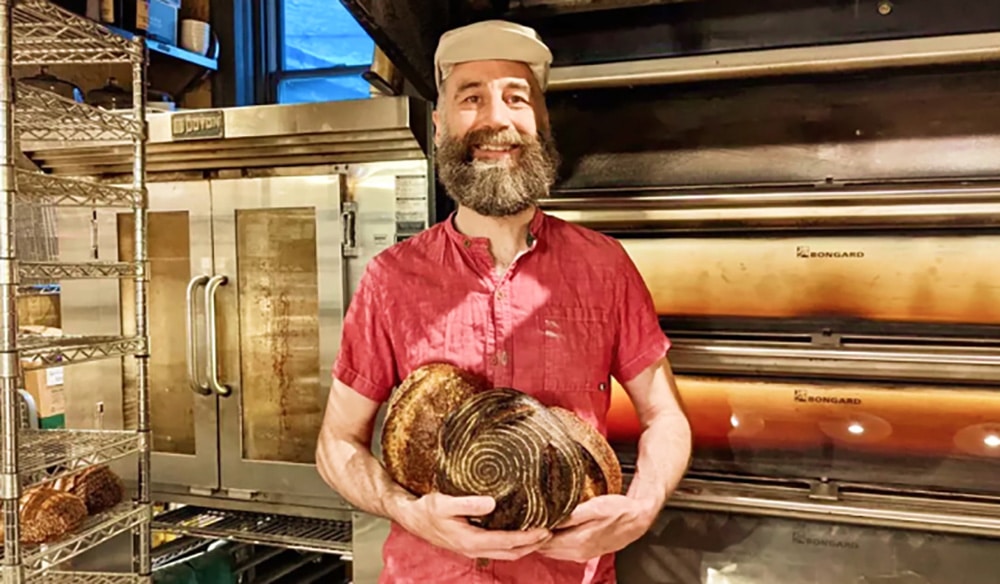
In 2015, Gus Reckel, a former venture capitalist who hails from France, transformed a shuttered print shop into the buzzing French bakery, L’imprimerie.
Reckel spent long hours in the Brooklyn bakery, whipping up small-batch bread and pastries from local and organic ingredients. He even raised bees for honey — an ingredient used in baking — on the roof.
Each day, Reckel and his 18-person team served roughly 175 customers, or about 64,000 customers per year.
But in September 2023, after Reckel’s husband lost his mother, the couple experienced a moment of clarity. “Why are we pushing so hard, and what are we sacrificing in the process?” they wondered.
“After a decade of being tethered to the bakery with no personal life, we realized that if we could sell the bakery, we’d have enough money to retire and focus on each other,” Reckel said.
With the decision made, he began reaching out to business brokers to explore his options.
Building L’imprimerie, a dream bakery, from scratch
In 2014, Reckel purchased the 1920s brick building for $1.25 million, according to Realtor.com. The property includes one storefront, three apartments and a garage.
Buying the building and setting up shop was a deliberate, long-term strategy. Rent from these spaces helped cover mortgage payments — and Reckel even lived out of a small studio on the back of the property for a few years.
“My original 2014 plan was to work for 15 years, pay off the mortgage and live off the rent from the building,” he explained. “This real estate investment provided both operational stability and long-term financial planning for the business.”
L’imprimerie opened its doors in 2015. A month later, Edible Brooklyn reported customers lining up at 6 a.m. The bakery clearly filled a neighborhood gap.
“It is not just hipsters who like this,” Reckel told Edible. “We have customers who work at [Wyckoff] hospital, Latino people, all the people like good bread.”
For nearly a decade, the bakery cafe fed the community baguettes, croissants, quiches, tartines — and “the absolute best chocolate chip cookie in New York,” according to Grub Street.
When the pandemic hit in 2020, L’imprimerie pivoted quickly, offering online ordering, delivery, and new products, like a sourdough mix, a pizza kit, cookie dough, pantry staples — and even wine.
Reckel frequently posted on Instagram, sometimes multiple times a day, with inventory updates. The bakery didn’t close for a single day during COVID, he shared.
“We did adapt by the hour, as we learnt more about the virus,” he said. “We were the only people our customers would see during their entire day, and they only left their place once a day, to come to us, so we tried to help the best we can, while protecting our staff.”
By 2024, L’imprimerie’s annual revenue had grown to $1.56 million.
But with success came burnout.
“My biggest challenge was that I never figured out a way to not be available 24/7,” Reckel said. “The business was very centered on me, and while the beginning was fun, I eventually burnt out. The bakery essentially made it impossible to have a life outside of work.”
That reality became a key factor in his decision to sell.
Selling a bakery through a business marketplace
Nearly a decade after opening L’imprimerie, Reckel explored selling both the building and the bakery — but ultimately decided to sell the two separately. He worked with Baton Market, a business-for-sale platform.
“I chose them because they were cheaper and offered a data-driven, price-based approach rather than traditional ‘wine-and-dine’ brokerage,” Reckel said. “I appreciated that the team was available for brainstorming and valued their M&A background.”
Here’s how Baton Market works: They provide a free valuation, then list the business on a marketplace with qualified buyers. Unlike many marketplaces, they also do some strategic buyer outreach. Sellers choose from three pricing tiers, each with a monthly retainer ($500, $1,000 and $2,000) that gets credited back at close.
For the two lower-priced plans, sellers are charged a 6% success fee, which is around half the cost of traditional broker fees, but similar to other marketplaces. The Premium plan follows the Double Lehman formula, which is comparable to typical broker fees.
Within weeks of listing, Reckel received about three Letters of Intent (LOI), and then the advisory firm guided him through the evaluation and negotiations.
The hardest part, Reckel said, was operating the bakery cafe while also navigating the sale. Selling was also deeply emotional — but Reckel has no regrets.
L’imprimerie sold to an undisclosed buyer for 7 figures, including seller financing, in November 2024. Reckel trained the new owner in a four-week transition, then took some time off.
He spent three months in Ecuador volunteering at a plant medicine clinic. When he returned to New York City, he began consulting with restaurateurs and those wanting to buy or sell small- and medium-sized businesses. His goal is to start a YouTube channel focused on SMB sales.
And after working around the clock for a decade, Reckel is also working to reestablish his social life.
“After 10 years of doing nothing but work, I’m rebuilding my social life, learning how to reconnect with people, and fighting the stigma of ‘you don’t need to justify why you don’t work,’” he said.