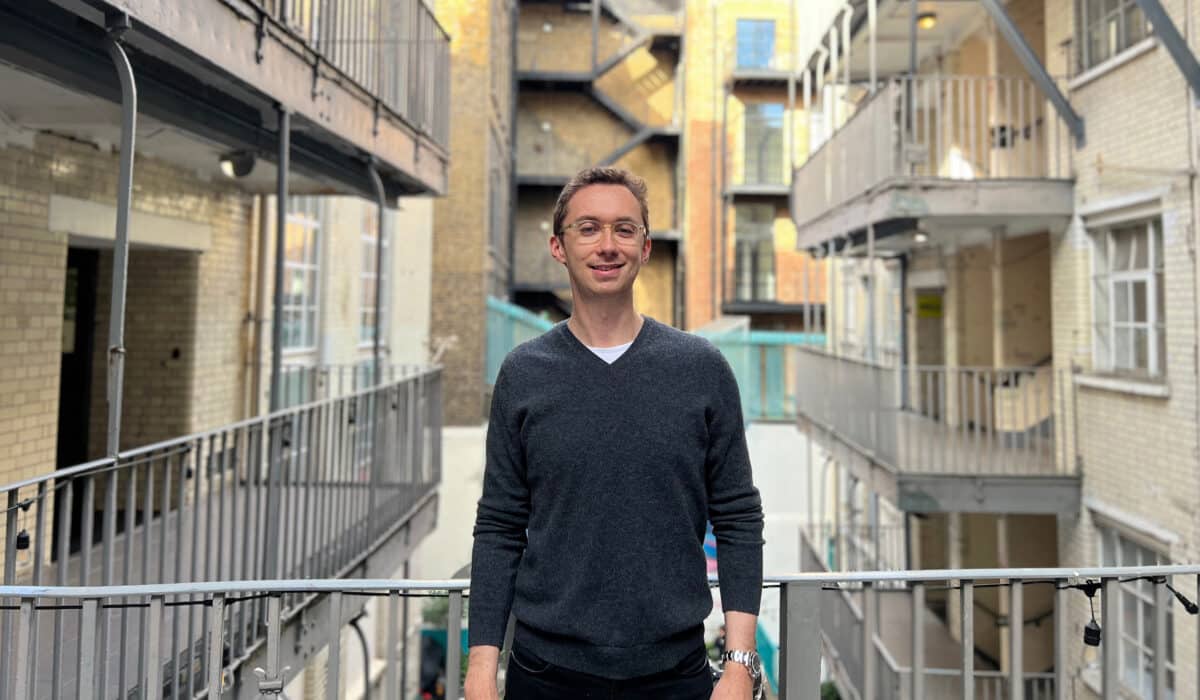
In 2013, at the age of 21, London-based Alex Price dropped out of college and began building websites. He grew his freelance business into a UX and digital marketing agency called 93digital, with the “93” as an ode to Price’s birth year — until he sold 9 years later for a 7-figure sum.
At first, Price ran 93digital as a generalist WordPress agency on his own, building websites for a variety of clients. He even redesigned the King’s College website just six months after he dropped out of the school, according to Bootstrappers.
In 2015, Price landed his first big project with a membership organization in the UK. It paid around $25,000, Bootstrappers reported, and Price used that traction to hire his first two full-time employees.
But even after these big wins, Price admitted to us that he felt imposter syndrome. He recalled living at home with his parents in the early days, being asked to empty the dishwasher one minute and switching into “CEO mode” the next to strategize with his team. He also remembered going to meetings where clients would mistake him for an account executive, rather than the founder.
“Being young… it was hard to be taken seriously,” Price told They Got Acquired.
His confidence gradually increased as the company grew. Price said his relationships with advisors, coaches and peer groups also helped him develop and grow into his role as founder.
Designing agency 93digital for growth
Still offering general WordPress services, the bootstrapped 93digital hit $1.5 million revenue in 2019. But then, Price said he felt like he hit a wall. That’s when he decided to niche down to work only with B2B tech and SaaS (Software as a Service) clients.
“The more niche and focused we became in selecting the clients we worked with, the faster we grew, which feels counterintuitive for most entrepreneurs,” he said. “This helped us have a more strategic conversation, elevate our proposition, charge more and win more work.”
Based in part on client demand, the company also began offering performance marketing services such as SEO (search engine optimization) and PPC (pay-per-click) campaigns. However, Price felt that doing so through 93digital would dilute its strong WordPress proposition and branding, so he launched a second brand, 93x. This strategy also allowed him to target a specific audience. For example, 93x ranked highly in Google results for terms like “B2B SEO agency.”
During COVID, which accelerated the growth and needs of many online businesses, Price nearly doubled the size of his staff to 35 employees. The 93digital team developed about 15 website projects per year and provided ongoing support for about 50 sites, while 93x handled digital marketing for 35 clients.
Together, the two brands rapidly moved toward a combined $3.5 million in annual revenue.
By the end of 2021, Price began to explore more opportunities for growth.
“Like a strange dating process”: How 93digital got acquired
Price considered raising money, acquiring a company or finding a buyer — “[I was] open to whatever might provide the most opportunity for our team and clients with a strong focus on cultural fit,” he said.
Price described meeting potential acquirers as “a strange dating process.” He said he was often surprised by how potential buyers would try to sell themselves to 93digital in initial meetings — not the other way around.
Through Andy Maher, a 93digital board advisor and a broker/M&A consultant, Price connected with Clarity, a global digital marketing and communications agency.
“From meeting lots of potential partners, I quickly learned that cultural fit was the most important thing in exploring any future growth opportunities — acquisition or otherwise,” Price said. “I knew from my first meeting with the Clarity leadership team that it felt like the right fit.”
Price decided to take the acquisition route, which he described as a mentally draining process. He felt as though he now had a second full-time job overseeing the sale process on top of actually running the company.
“You also start to feel quite vulnerable as you share every single detail of the business with the acquirer,” he added.
Ultimately, Price said the process was worth it, and 93digital was acquired for 7 figures in April 2022.
Now, Price is the managing director of digital experience at Clarity. He also works with entrepreneurs as an angel investor focused on B2B, SaaS and tech.
Price’s biggest piece of advice to entrepreneurs looking to sell? “Start planning now,” he said. “It’s never too early to adopt the ‘Built to Sell’ mentality.”
Update: What Price did after the sale and his reflections three years later
🔹 TGA: What have you been up to since you sold your business?
Price: After spending a year and a half working for our acquirer, I left and took some time to travel and recharge. I was more tired than I thought, and the period working for our acquirer was more draining than expected.
I then started doing some board advisory work for other agencies, some angel investing and helped to setup a new AI first SEO agency as an investor and director called FirstMotion.
I’ve finally launched a new project of my own called Undiluted, where we’re building the leading media and intelligence platform for the venture debt and growth lending ecosystem.
🔹 Did you take time away from working after selling?
Yes, I took a full year off. It was one of the best years I’ve ever had.
I said yes to every opportunity and every trip and didn’t think about work at all. I had a chance to completely recharge.
I spent two months skiing, celebrated Saint Patrick’s Day in Ireland, scuba dived in French Polynesia, cycled across the Alps from Geneva to Milan, camped on the roof of a Land Rover in Scotland, got married and honeymooned for two months with my wife in Fiji, Australia & New Zealand.
🔹 How did you figure out what was next?
I didn’t follow a formal process. I’m not a fan of forcing big decisions and feel they have to come naturally. At times I felt a bit lost and as though I’d lost my momentum, but I kind of expected that.
Eventually I spent some time thinking about which parts of my last business I enjoyed the most, what I think is valuable and future proof with AI changing everything, and what would feel like I was taking a step forward based on everything I’d learned from the previous business.
🔹 How did the money from your transaction affect your life path?
It gave me breathing room and time to find what to focus on. It put me in a position where I have no mortgage or debt of any kind and could live off my investments without worrying.
🔹 What surprised you most about life after the sale?
Beyond the financial security, the money really changed very little, and I actually had an even stronger desire for fewer possessions and a simpler life than before. Most of the things I thought an exit could buy me I lost interest in very quickly.
🔹 What advice about the post-exit period would you give to founders?
A lot of advice I heard from others before selling was to know what you want to do before selling. But I felt I couldn’t work that out until I was completely detached from the last business, so don’t be afraid to do the same.
Take some time before rushing into the next thing, and know going into it that you might at times feel a bit lost or uncertain, but that’s part of growing personally.
🔹 Is there anything you wish you did differently after you sold the business?
I would have found some office space a bit sooner and made sure I was not always working from home. I found it hard to find energy and inspiration for something new always being at home.
I love my home office but eventually realized I really needed a change of environment as well.
Editor’s note: Price’s responses were edited lightly for clarity.