>> Lexi Grant: This is a special episode of they Got Acquired. We just launched our new course, the Exit Playbook, which teaches you how to build your company in a smart way now so you can sell for more later. As part of that course, we interviewed Lauren Colson, a CFO who helps founders get their financials ready for a sale. And while my original intent was to keep this interview only for course participants, I’m releasing it publicly, both so more founders have an opportunity to learn from Lauren and to give you a little taste of what our course covers. The ROI of thinking ahead about how to make your company more valuable. It’s huge if you understand what buyers are looking for and which levers to pull. It’s no exaggeration to say that you could add millions of dollars to your sale price. That’s what I teach you in the Exit Playbook, which you can join@playbook.theygotacquired.com we’re offering a, uh, $200 discount to podcast listeners. So use the code TGA PODCAST when you check out.
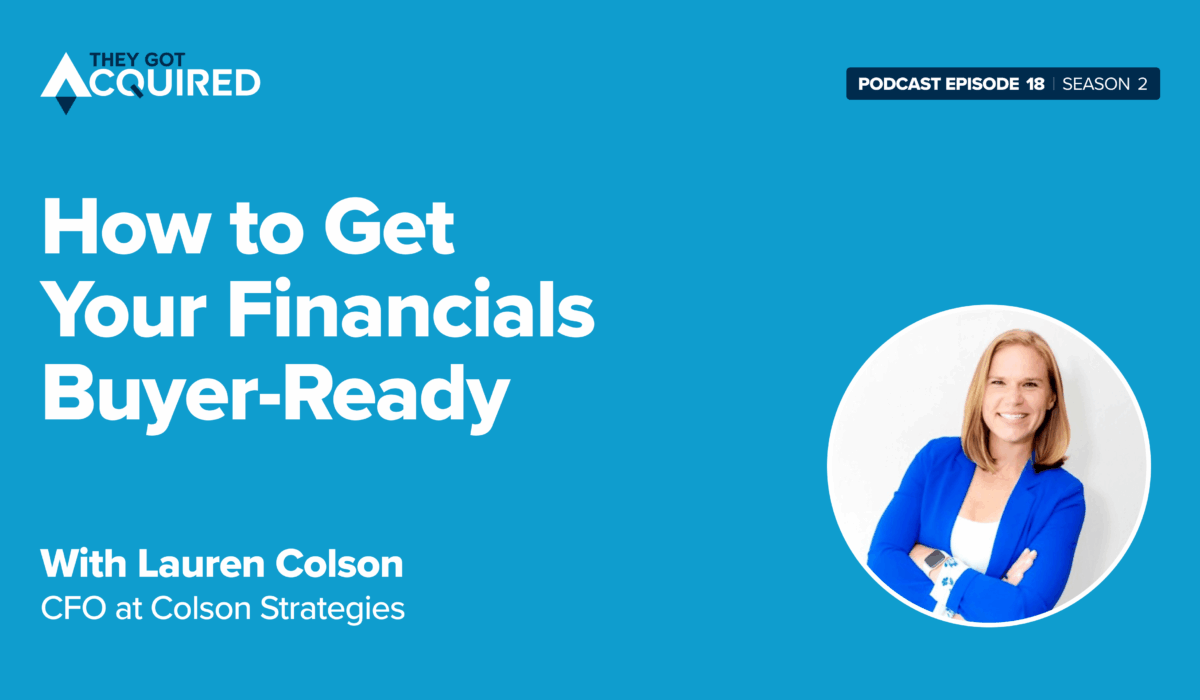
Again, that’s playbook.theygotacquired.com and the discount code is TGA PODCAST. Now here’s the interview. We all know we need to have our books in good shape for a sale, but what exactly does that mean? And if you don’t have an accounting background, how do you know what to look for? Today we’re talking with Lauren Colson, a CFO who runs Colson Strategies. I had the good fortune of working closely with Lauren when we were both at the Penny Hoarder. Lauren led the finance team there leading up to that company’s acquisition, and now she runs her own firm. One of the services Colson Strategies provides is helping founders prepare their financials for a sale. So, Lauren, I’m excited to learn from you and share your smarts with our listeners. Thanks so much for being here.
>> Lauren Colson: Thanks for having me. I’m so excited.
Colson Strategies provides accounting services to small and mid sized growing businesses
>> Lexi Grant: So can you start by sharing a little bit about your background and how you got here?
>> Lauren Colson: Yeah. So I started my career with a degree in accounting and finance and spent the early part of my career in corporate finance roles at large publicly traded companies. And that gave me a strong foundation in financial analysts analysis, technical, uh, accounting, SEC reporting, and highly structured audited environments. And from there I moved to a high growth startup, um, which is where we met. And uh, the need was less about historical reporting and more about supporting real time decision making. So I worked closely with the founder and key stakeholders, translating financial data to help them make informed decisions that shaped the Strategy and growth of the company. And that shift for me from, you know, reporting results to influencing outcomes really ignited my passion of, um, the numbers of people and ultimately became the foundation for building my own firm. And from there Colson Strategies grew organically. I started taking on clients through inbound demand and during that period also supported my prior company through a significant acquisition like you mentioned. So that was my first experience gaining, uh, hands on experience with transaction readiness and diligence and integration from the operator side of things. And today it’s been five and a half years since then. And we’re a team of 13. We provide bookkeeping, controller and CFO services to small and mid sized growing businesses. And you really can think of us as your accounting team to plug in. So we do everything from recording all transactions, paying bills, sending invoices, processing payroll, putting together budgets all the day to day up to the financial strategy, financial forecasting, cash flow, modeling, M and A support, uh, and just helping you grow your business.
>> Lexi Grant: Yeah, thanks for sharing that.
Typically founders want to work with an accounting team that understands M and A
And I mean, one of the reasons I wanted to talk to you specifically was because there are a lot of accounting firms that do many of the things you mentioned but might not have experience with M and A specifically. And typically we recommend for founders who are thinking about selling a business, they want to work closely with an accounting team who does understand the M and A side. Can you talk about like why that piece is important to bring to the table?
>> Lauren Colson: Yeah, absolutely, because the day to day accounting is super important. But when you’re thinking about M and A from the seller side, um, you want to make sure that the books are prepared in a standard way that can uphold a diligence process. And so for a team that has experience in that they know what buyers are looking for, what’s going to be scrutinized in a transaction, what risks could impact evaluation or deal structure, and um, what’s going to be needed for that diligence process. So, so preparing the books in those standards and with those things in mind and also having that experience of what the process looks like is really going to help set up the founder for success. Partnering with a financial partner like that.
>> Lexi Grant: Cool.
How can a founder know whether their books are clean enough for a sale
So for those of us who don’t live in the accounting world like you do, how can a founder know whether their books are clean enough for a sale? Like how do they know if they need a firm like yours to help? And I asked this partly because I’ve talked to several founders who, you know, thought they had their books were in good shape, they had a bookkeeper, but they Got to the point in due diligence where it was made apparent. Then, you know, the buyer realized that the books really weren’t as clean as they thought. And looking back, they said, like, what should I have looked for? Like, what flag should I have looked for to know that my books needed a little bit more fit us? So how would we recognize that?
>> Lauren Colson: Yeah, so I see a couple different scenarios. There’s a lot of founders I talk to that just have a gut sense that something’s off with the numbers. So they can’t pinpoint it and say, I know XYZ is wrong, but they know their business and how it operates. But the numbers that they’re receiving aren’t lining up with how the businesses are performing or what they know. So that is often can be a signal.
>> Lexi Grant: So just like a spiny feeling that, like, it’s not exactly where it should be.
>> Lauren Colson: Exactly. Because, you know, if, if the founder isn’t very involved with the sales cycle, you know, they know what the those numbers should be and how that may translate to cash, but then they’re not seeing that on the financials. And their bank balance is a lot lower than they think. So they, there’s some sort of disconnect that’s not giving them comfort in the numbers, but they can’t put their finger on it. And for those that think that the books, uh, may be in good shape, I’d say one of the signals there is that if they’re not reviewing the financials and gaining insights and clarity and using them to make decisions, then that may be a, uh, strong indicator that they’re not in good shape because they’re not being used in a way that’s helpful for the business owner. And so if you think, if it’s not giving them insights on information, you think, how is a buyer going to look at this and kind of understand what’s going on in the business? And if, you know, they’re not looking at the financials at all and they’re just relying on their bank balance when they’re trying to make decisions, that can be another, like, well, well, why isn’t. Either their books aren’t clean, or their partner is not communicating and giving them the insight in a fashion that can help them feel confident in their numbers.
>> Lexi Grant: Yeah, those. That’s one of the things that I really appreciated about you when we worked together is I felt like you layered on this, like, common sense layer of, like, what do these really mean and how do they affect how we operate day to day? And for people that don’t have that accounting background or a finance background. Sometimes we don’t have that innately for sure.
>> Lauren Colson: And that, and that’s where the way that we operate is. We don’t expect you to. You’re not the accountant, you’re the business owner. And you have your own other skill set that’s, you know, drawn you to start the business. So we need to make sure that we’re preparing the financials and supporting and communicating in a way that makes you feel confident and understand what’s going on from the number side of things.
>> Lexi Grant: Mhm. When you review a set of books, I imagine there’s like a vast variety of, like, some of them need a little bit of review, some of them need a lot. It’s like, can these projects really have a big range?
>> Lauren Colson: Absolutely. And it depends on a couple different things. It depends on the complexity of the business. And I want to call out that doesn’t mean the size of the business, because you can have a $60 million revenue business that’s really straightforward and the accounting is quite simple. And you can have a smaller business that is much, uh, you know, 100k in revenue. And it’s quite complex because of what they do. So, um, understanding, you know, where they fall in that range can depend kind of how much work maybe needs to be analyzed or reviewed and, you know, the scope of what that, you know, cleanup may look like. And the second part of that is it depends on the period, you know, how, how wrong are things and what kind of period are we looking at? Because, you know, a lot of times we want to get at least, at least 12 months of historical data. So, you know, if there’s a lot of inconsistencies and things that need corrected, that could be potentially a big lift, especially if you’re going back 12, 24, 36 months.
>> Lexi Grant: Yeah, that makes sense. Cool.
Can we talk a little bit about the difference between accrual and cash accounting
Can we talk a little bit about the difference between accrual, uh, and in cash accounting? Because I know this is something that comes up ahead of some sales for most businesses, not the small ones can kind of get out of this sometimes. But for most sales, the buyers are looking for accrual, uh, accounting. So I’m wondering if you can explain the difference here and why one is preferable for an acquisition.
>> Lauren Colson: Yes, and I’ll just have to say I’m a nerd and this is one of my favorite topics to talk about. So put simply, cash basis accounting records the transactions in the financials, when cash moves in and out of the bank account. Uh, accrual accounting records the transactions so the revenue and expenses in the period in which they are earned or incurred, regardless of when cash changes hands. So to give you a simple example, if an annual contract from one of your customers is paid upfront on the cash basis, the full payment is recorded as revenue in the month the cash is received, um, on accrual basis, that revenue would be recognized over the period the work is performed. So if the work is delivered evenly across the year, that revenue would be spread evenly across the year as well. And so I think one of the reasons it’s preferred in an acquisition and just personally from my CFO work is my preference is, is because it shows the true economic performance of the business. And so from a uh, buyer perspective, they’re evaluating profitability, margins, growth, trends, sustainability and cash basis can distort those signals because it mismatches the revenue expenses so it makes individual months look artificially strong or weak where accrual shows true monthly profitability. Uh, uh, you can understand seasonality within a business, evaluate gross margin, look at historical trends, and it’s just a, uh, consistency that’s really critical for evaluation.
>> Lexi Grant: Yeah, that’s helpful.
E commerce companies typically stock up on inventory in advance of peak sales
And I mean, I think the seasonality piece is interesting too because I do talk to a lot of founders who say they’re running an E commerce business where they make a lot of their sales around Christmas time. How does that work with the record keeping?
>> Lauren Colson: So it depends when the purchases are made. And so with E Commerce you’re getting usually the purchase and the cash received are on the same day. Right. If you’re purchasing something online, the customer pays, but the company has most likely purchased that inventory previously. Right. You stock up on your inventory especially for periods where you know you’re going to have high sales. So let’s say, you know, they buy a lot of inventory in August to Prepare for uh, Q4. So on the cash basis you would have all of that inventory recorded as an expense in August. So you may look severely unprofitable in August, but that’s not the case. That’s just your inventory you purchased. Where then in Q4 you may look, you know, extremely profitable because all you have coming in is revenue, um, because you don’t have the associated inventory costs in the, in that month. So it’s going to distort profitability and it’s also not going to allow you to see, well, what are the margins in those months. So those are highest sale months. But how are we actually performing and what it may be that we’re only selling our lowest priced product, so we’re actually not that profitable, but we can’t really tell because of the revenue and expenses being in different periods in different months.
>> Lexi Grant: That helps explain it. Thank you very much for that.
Do you often see founders come to you with cash books, then you have to move
So do you often see founders come to you with cash books, then you have to move them to accrual?
>> Lauren Colson: Very often, yes. And sometimes it’s just kind of going back to what uh, we were talking about earlier. Sometimes it’s not that hard and sometimes it’s a really heavy lift to do that.
>> Lexi Grant: Mhm. What are some of the other mistakes that you see business owners making with their books when they come to you?
>> Lauren Colson: We see a lot of the same trends over and over and I’d say no shame in this because a lot of people don’t know and it’s not about negligence in the business but oftentimes their businesses are growing faster than their financial infrastructure. And so some of the common mistakes we see are including personal expenses in the business. We’ll um, probably talk a little bit more about that later. Incorrectly or, and inconsistently classifying expenses. You can see the same expense in multiple different lines and areas within the financials and setting up the financials, the chart of accounts in a way that’s hard to read or interpret which then just becomes one difficult for the business owner or any third party to read but especially a buyer when they’re trying to kind of understand performance as well.
>> Lexi Grant: Mhm. Mhm.
QuickBooks Online is by far the most common system we see for small businesses
What about QuickBooks? Like is QuickBooks the standard now? Because I’m wondering if you get a lot of founders coming to you who aren’t in QuickBooks, whether you suggest they move in or what is like what are the kind of common preferred tools.
>> Lauren Colson: Yeah. So I would say QuickBooks Online is by far the most common system we see for our small to mid sized businesses. And I uh, think for most companies can run really successfully on it and scale and go through a sale. It’s not always my top recommendation for inventory based companies, heavy uh, companies that hold inventory and do manufacturing because there’s just more components there and it just doesn’t have the vigor. That said, I uh, always recommend an accounting platform or system. So um, it’s I’d say rare that people come to us these days with just a spreadsheet. Um, although we’ve certainly seen it happen over the years. And so we’re, we will, we will essentially not work with someone unless we can get them on an accounting software for you know, process and control and audit purposes. But there’s some other, I mean with AI there’s a lot of new systems popping up that some of our clients have shown interest in. So we’ve actually been exploring, you know, what other tools, whether it’s something we can layer on top of QuickBooks Online or um, something that may be another solution for uh, clients in different industries, uh, what may be the right tool. But I’ll say confidently right now we love QuickBooks online.
>> Lexi Grant: Mhm.
Some founders make the mistake of putting personal expenses in the business
Cool. And you mentioned earlier that some founders make the mistake of putting personal expenses and tracking that in the business. I’m hoping we can talk about that for a minute because one of the things we try to explain to founders is like the difference between EBITDA and SDE and you know, rather than me explaining it, maybe you can explain it to us and um, talk through why one sometimes makes sense over the other.
>> Lauren Colson: Yeah. So oftentimes in smaller kind of owner operated businesses, those are the where we may see more personal expenses actually running through the business. And what we want to make sure we see in, or what gets calculated in ste, which is called sellers discretionary earnings is taking net income and adding back items like what the owners founders are paying themselves which could be you know, above and beyond a salary and distribution but could be gym memberships, meals, travel, whatever. Just personal is included in the business along with you know, non recurring expenses. And that part um, is the same for an EBITDA calculation as well. But you want to pull out for example if there was a lawsuit that was a one time situation that involved a trademark or whatever it may be, you know, know that’s not indicative of the company’s performance because that was a one time situation. So that’s something you could add back in those calculations. But it’s, it’s important to think about. It’s not just adding back and inflating your net income because sometimes if you, if you overdo it, it may not make sense that buyers want to account for what the like market rate compensation is for certain key roles in the business. So you don’t want to maximize add backs on paper, but more so normalize the financials in a way that reflects how the business would run under new ownership without the owner involved.
>> Lexi Grant: So you’re basically trying to give the buyer a really good sense of how much money they would make from the business.
>> Lauren Colson: That’s exactly right. And if the owner is very involved in the business and knows that they want to step away, then they may have to hire an operator to fill that role. So those are the kind of things that they’re looking at when they’re trying to normalize those Numbers.
>> Lexi Grant: Yeah, I find for the bigger businesses, you know, if someone’s selling and they’re using ebitda, they usually have an accounting firm that’s doing it for them. But sometimes we do talk to founders of much smaller businesses who would be better off using SDE when they go to sell. And a little like even smaller add backs will make a big difference for them because if they’re selling on a multiple.
>> Lauren Colson: Right.
>> Lexi Grant: They’ll get that back three or four or five times, but they don’t know like what to add back or how to even calculate sde. Is that something that they need to ask an accounting team for? Can you do that on your own?
>> Lauren Colson: I could say you could definitely do it on your own. But when you’re talking about to your point that even small amounts add up when you’re looking at a multiple, it’s something that you would want to consider using a firm to help you calculate because that’s going to be to your benefit. And when we talk about these add backs in one time situations, the cost of hiring an accounting firm to help you calculate SDE could actually be considered a one time expense. Right. Because that’s not the normal course of your business. So when you’re thinking about kind of the cost benefit analysis, you want to make sure that you capture everything in there if you’re going based off of that kind of multiple, because it will really pay back.
>> Lexi Grant: Yeah, I think this is where like the visibility into financials can really help, especially the smaller businesses, the bigger ones too, but they usually tend to have more support for the smaller ones. It’s like getting this right could help you take home a lot more money.
>> Lauren Colson: Well, absolutely. And it’s like having, whether it’s yourself as an owner doing it or having a strong partner that keeps you organized is going to make sure that you don’t miss anything. Right. Because think about, I mean, sometimes it’s hard to think back on what you did last week. And if you’re going through and doing an analysis of, you know, what was this charge 12, 24 months ago, whatever it may be, you may not remember. So that may, you know, you may not include something as an AB back where you should, but if you have everything clearly documented and things categorized in the correct account, it’s just going to make it so much easier for you and give you the confidence that you’re getting the highest value possible.
>> Lexi Grant: Yeah, that really makes the case for thinking about this ahead of time. Like even if you don’t want to sell for three or five years if you can get the tracking processes and the support you need in place, um, it’s like one of the easiest things you can do ahead of time to set yourself up for a sale down the line.
>> Lauren Colson: Couldn’t agree more. And it’s really taught to your benefit as well because being set up for a sale is just going to give you more clarity and information around your financials, you know, for years to, to come that will help you prepare and maximize value for your company.
>> Lexi Grant: So yeah, it helps you make the best decisions along the way.
>> Lauren Colson: Exactly. So it’s really a win win.
>> Lexi Grant: Mhm. Yeah. We found that with like a lot of the things that we’re recommending people do is it’s good for the sale, but it’s also good for you as an owner even if you never sell the business.
>> Lauren Colson: Yes, exactly, exactly.
Do you have any other advice for founders that are aiming for an exit
>> Lexi Grant: Do you have any other advice for founders that are aiming for an exit that we haven’t covered yet?
>> Lauren Colson: I just echo it one more time. Uh, my biggest piece of advice is always you can never start preparing for an exit too early. To add on to that a little bit is we often get called in when people are ready to go to market to sell and we do an analysis and there’s a lot of work to be done and it can be costly, it can be time consuming and so, you know, getting prepared like you said, I’d say like at least a year before is definitely going to be to your benefit. And I would say another thing to think about beyond the numbers is reducing dependency on yourself. So you know, a lot of buyers are looking for businesses that can operate without the founder in the middle of every decision. And so clean financials absolutely matter. But so do you know repeatable processes, clear roles, SOPs and the ability to continue performance without founder dependent knowledge. So that’s another thing to be thinking about as you’re preparing, you know, down the road in the next, you know, three to five years.
>> Lexi Grant: Yeah, that’s great, that’s really helpful. I love how you break this down in like uh, a really down to earth way. So thank you so much for taking the time and teaching us. If anyone wants to get in touch, what’s the best way to find you?
>> Lauren Colson: Absolutely. Thanks for having me. And you can find me on LinkedIn, LaurenCoulson or you can reach out at infooulsonstrategies. Ah dot com.
>> Lexi Grant: Awesome. Thank you so much Lauren. I appreciate it.
>> Lauren Colson: You’re welcome.
>> Lexi Grant: If you found this interview helpful, we’d love to see you in the exit playbook. That’s our new course that helps you build your company in a smart way now so you can sell for more later. And don’t forget to grab our 200 discount for podcast listeners by using the code TGA podcast. Visit playbook.theygot acquired.com and use the code TGA podcast. I’ll see you there.


 They Got Acquired on Apple Podcasts
 They Got Acquired on Spotify
 They Got Acquired on Amazon Music
